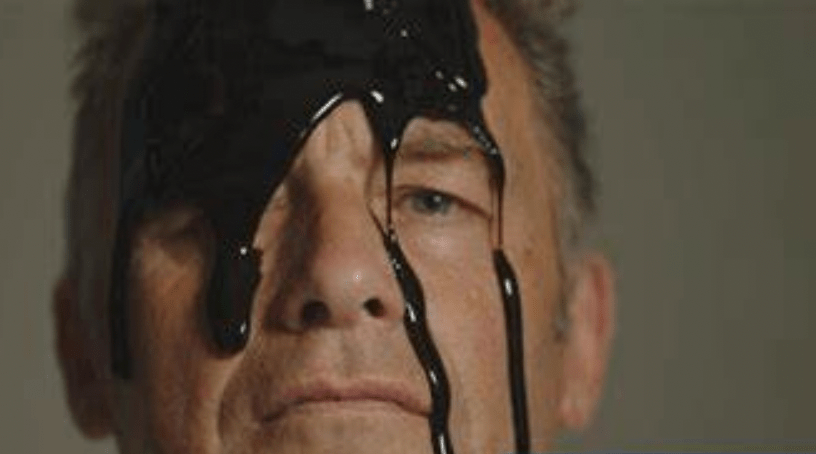
The evening before our first EcoCit People’s Assembly we gathered for a screening of Chris Packham’s C4 documentary Is it time to break the law?.
We began the ensuing discussion by asking everyone to first say how Packham’s film left them feeling. Anger, respect, overwhelm, determination came up, and as people spoke, a common sense of recognition.
Reflecting on the film there were one or two voices quite trenchantly opposed to Just Stop Oil’s approach to levering change (I’d forgotten how JSO-focussed Packham’s story is). There were many more who were either in broad favour of it or actively invested in the campaign. A good few were preparing to take part in JSO’s upcoming Slow Marching wave, and currently mobilising others to join them.
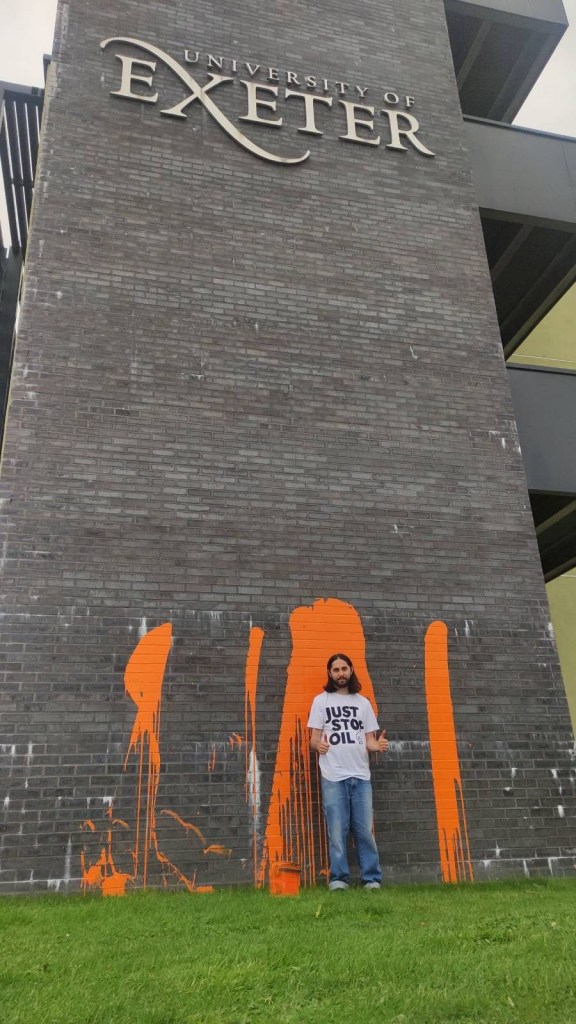
One of the latter was Falmouth Illustration alumna Holly Astle, who’s campus action with Exeter graduate Ethan Paul the following day was to catch most of us off guard, as we mulled our hypothetical replies to Packham’s question. Holly’s action in particular was to rather dramatically reframe that first PA.
Packham’s film focusses on whether breaking the law is justified in the context of resisting the knowing and wilful destruction of our biosphere, to which the answer is surely an unequivocal Yes. Behind this, though, another question slipped into the room as we gathered ourselves to talk. Unmentioned by Packham, it was this question which quickly became the focus of our discussion: Justified it may be, but does disruptive civil disobedience like JSO’s actually do anything to help?
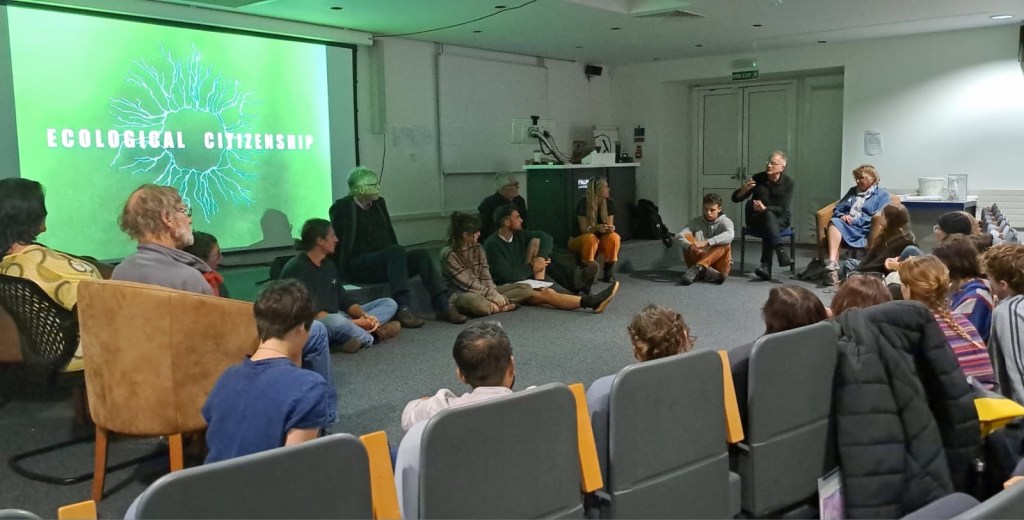
The following day’s PA was planned to address the question “In the context of the climate and nature crisis, how do we bring about infrastructural change to empower individual action?”. Thrashed out the week before in a Question Formulation Technique session with 60 people, it wasn’t as well honed as in previous PAs, but was more than good enough to work with.
What happened the next day was that we turned up to find the building in which our PA was to be based plastered in orange paint, this having been done by one of our own. Armed with a paint-filled fire extinguisher Holly had offered her own reply to Packham’s question shortly before we arrived, and was by now on her way to a Camborne police cell where she’d spend two nights before any of us heard from her again.
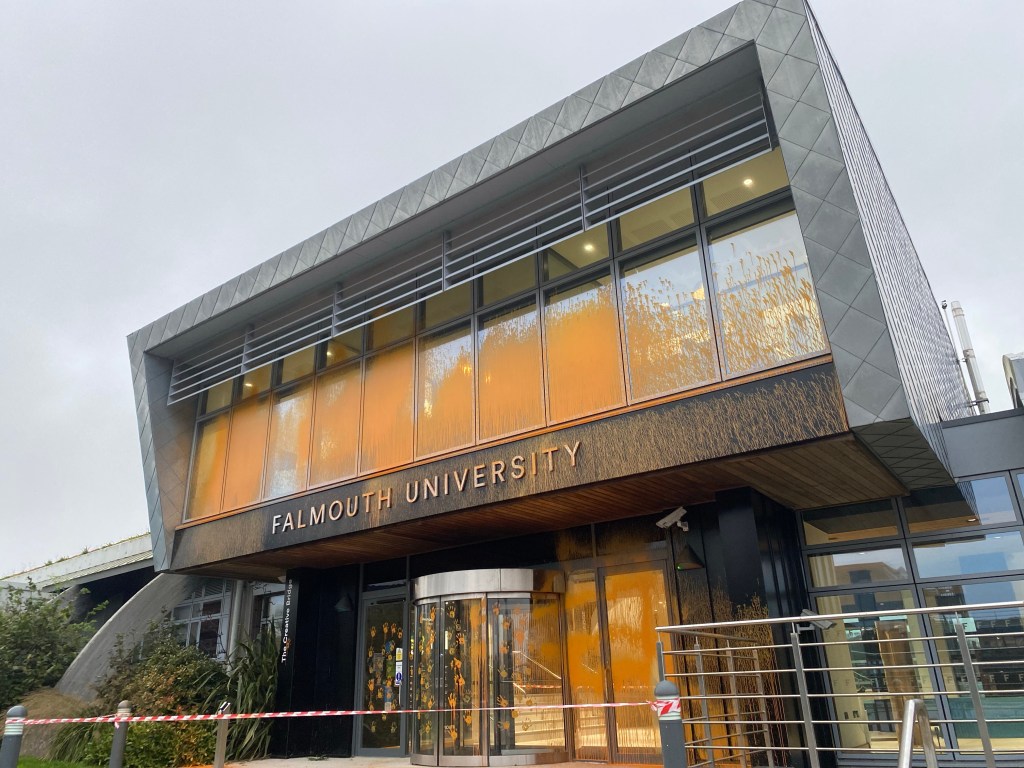
Not surprisingly, then, the session opened in a fairly charged atmosphere. What struck me on arrival was a palpable sense of confusion, scepticism and tension among some of those present, concerning Falmouth Vice Chancellor Emma Hunt’s office (which happened to be directly above us) having been targeted, despite her active support of our Ecological Citizenship venture.
This dissonance included some who’d been vocally supportive of Just Stop Oil the evening before. By comparison there seemed to be a more or less unanimous agreement that Exeter roundly deserved Ethan’s slops of orange paint in light of their high profile partnering with – and greenwashing of – Shell.
We decided to adapt our plan to allow the emotions present in the room to be voiced. Once again we opened the session with a check-in that invited people to say how they were feeling. And as before, expressions of unease were noticeably outnumbered by those voicing gratitude, relief, exultation even – the latter coming from lecturers as much as students, interestingly.
One thing in particular stayed with me. Discussing the local Tory MP’s jibe about Holly and Ethan’s wanton ‘acts of vandalism’ an Exeter colleague remarked that “the real act of vandalism would be to clean the paint off. It should be left there to bear witness to what these universities have done”.
How seriously that comment was intended I don’t know, but I mean to come back to it.
 Seacrow Letters
Leave a comment