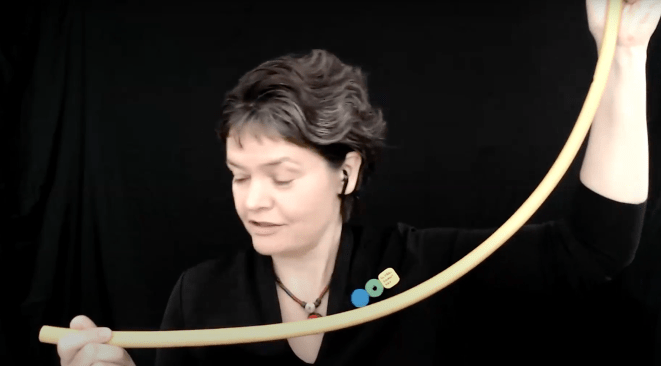
During a live-streamed talk for Donut Day 2023 economist Kate Raeworth speaks of how those of us living and working within academia are used to thinking carefully and critically with words.
“Meanwhile” Raeworth observes, “images slip in quietly through our eyes, taking up residence in the back of our brains”.
Pulling out a length of rubber hose Raeworth performs the image nestled at the heart of 20th Century growth-based economics: the infamous exponential curve now more darkly and ubiquitously familiar as the repeated visual score of an accelerating, too-big-to-see biospheric unravelling.
Raeworth speaks of how such internalised images shape our assumptions, deciding which factors and priorities are thereafter placed in the centre of our vision, which get consigned to the periphery of our attention, and which quietly slide off our cognitive screen unnoticed.
As many others have done Raeworth speaks of the radical incoherence of an economic system based upon the cluster of gravity-defying assertions which this growth curve embodies – its sudden upwards lunge showing us without any nuance of doubt that this can only end one way – the way unfolding around us right now, as an already-present reality.
Yet even faced with a gathering wave of devastation the mantra of ‘continuous growth’ is still asserted by our political and cultural institutions – not least by our own university, gaslighting itself and anyone who’ll listen with the digital wonders being fostered here at the “nexus of creativity and technology”. As if continued economic growth could somehow be dematerialised: magically uncoupled from the parallel increased consumption of ‘natural resources’ that inevitably follows in its train. As if continuous growth were not code, then, for completing this culture’s extermination of the living world within the span of one or two human generations: on our watch, as the saying goes.
Raeworth’s celebrated contribution to this predicament has been the formulation of a reimagined ‘economics for the 21st Century’: a reformist assertion of hope named after its primary image, the ‘donut’ between who’s inner and outer edges – inclusion within the common wealth and remaining within ecological boundaries – we might now reimagine “a culture of inhabitation” as the ecological philosopher Derrick Jensen put it back in 2011: a culture that’s re-learnt how to behave “as if we planned on sticking around”.
 Seacrow Letters
Leave a comment